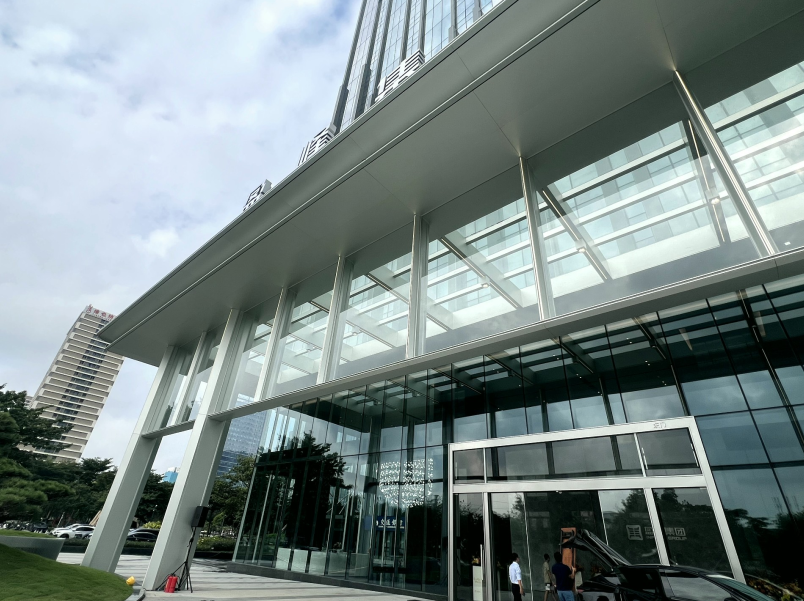
AA25 Anodised Aluminium Panel Application Project (Shunde Yingfeng Group Headquarters)
Project Name: Shunde Yingfeng Group Headquarters.
Anodised coating thickness: AA25, 25 micrometres.
Aluminium panel type: Sheet metal formed and then anodised.
Application: Outdoor curtain walls and interior decoration.
Forming followed by anodising (commonly referred to in the industry as ‘anodising of shaped components’) is the mainstream preferred solution for achieving a high-quality appearance and protection for aluminium panels. Its core advantages lie in the integrity of the coating, consistent appearance and the absence of creases or cracks; however, it does present the challenges of high costs and low efficiency.
I. Core Application Advantages (Why Choose It)
1. Appearance and Texture: Absolute Perfection
Comprehensive anodising coverage: All surfaces following bending and punching (including flanges, internal corners and cut edges) are fully covered by a uniform anodised film, with no ‘white edges’ or ‘bare aluminium’ areas.
2. No Flange Cracks: Avoids the defects of ‘anodising before forming’, where the hard, brittle anodised film cracks or peels at the bends.
3. Protective Performance: 360° coverage with no blind spots.
The anodised coating never peels off: The coating is formed through the electrochemical conversion of the aluminium substrate (metallurgical bonding), not a paint coating, and will absolutely never flake or peel.
4. Fire Safety Requirements: No organic coatings, pure metallic finish, Class A fire rating, and no toxic fumes.
II. Cost and Efficiency Challenges
1. Significantly higher costs (≈ 30%–50% higher)
Individual-piece processing: Unlike flat sheets, which can be anodised in rolls, production is limited to individual pieces or small batches using hanging fixtures, resulting in a sharp increase in labour, fixture and energy costs.
2. Yield pressure: If handling is mishandled during post-forming handling, the entire finished piece is scrapped.
Guangdong Anlv New Material Co., Ltd. is a modern enterprise focusing on the research and development and manufacturing of precision pre-treated aluminum plates.